
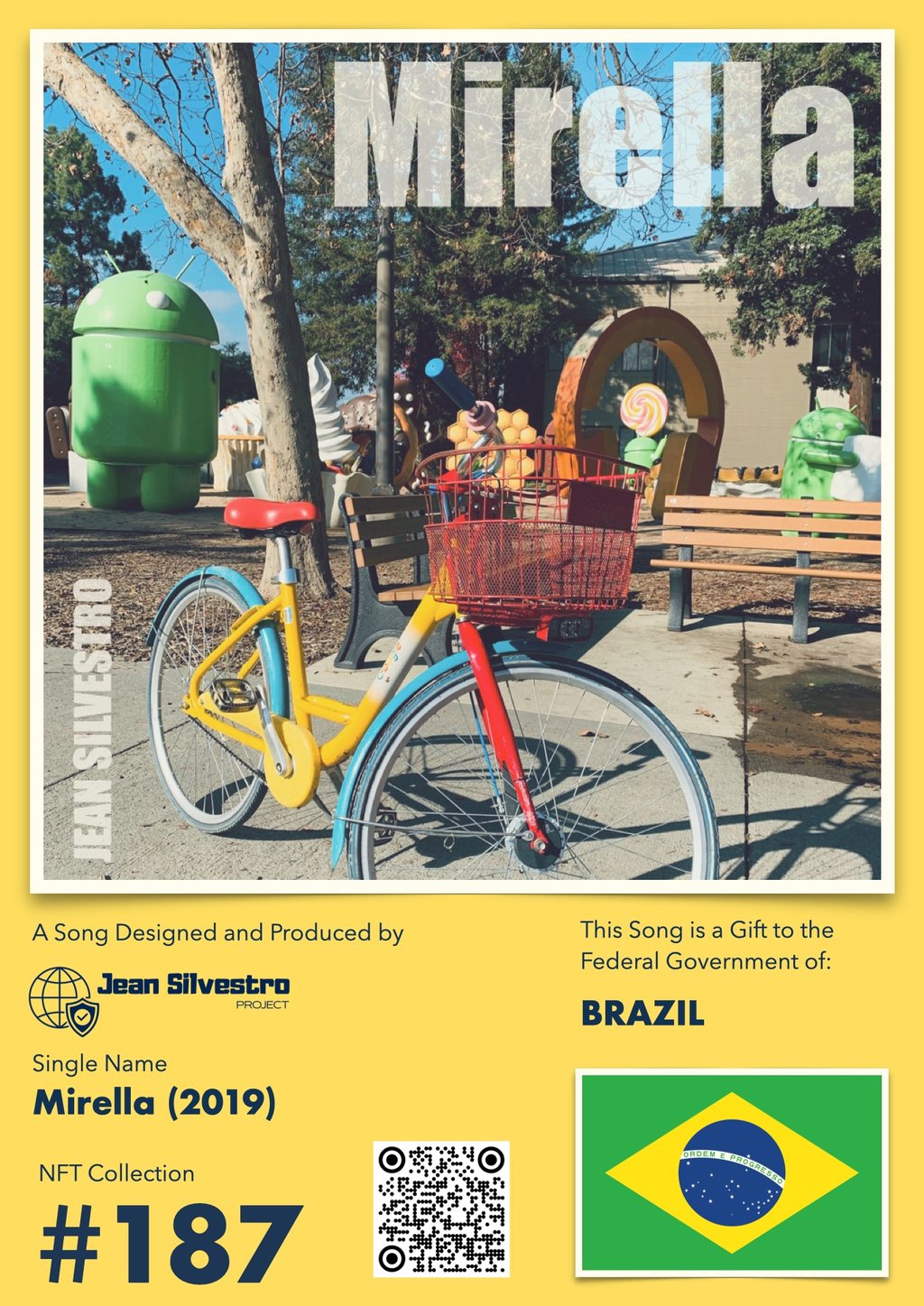
#187 Mirella (2019)
Lyrics
Mirella
Sorriso
Inocente
Beijo
De repente o coração
Acelera e sente
Saudade
Tô carente
Tento
Resistir à tentação
Não morrer de Paixão
Mirella
Eu sempre vou te amar até o infinito
A tua imagem no meu rosto
Eu quero tanto o teu Amor
Me leva com você
Mirella, empresta o teu sorriso
Tem coisas que eu só vou dizer no teu ouvido
A tua imagem no meu rosto
Eu quero tanto o teu Amor
Me leva com você
Segredos
E momentos
Juntos
Eu não quero mais ninguém
Só eu e você
Bem perto
Estaremos
Sempre
Vou te amar e proteger
Eu abraço você
Mirella
Eu sempre vou te amar até o infinito
A tua imagem no meu rosto
Eu quero tanto o teu Amor
Me leva com você
Mirella, empresta o teu sorriso
Tem coisas que eu só vou dizer no teu ouvido
A tua imagem no meu rosto
Eu quero tanto o teu Amor
Me leva com você
Mirella
Eu vou dizer no teu ouvido agora
Palavras de Amor, nosso segredo
Meu coração vai te levar comigo
Mil coisas pra dizer no teu ouvido
The Secret and Inspiration
Lisbon has a different light at the end of the afternoon, and Rafael has learned to measure his own silences by it. Sometimes he walks the streets of Alfama, observing how a city can remain intact while everything inside someone crumbles. The facades remain the same, tourists continue photographing old windows, the Tagus reflects gold as it always has. But he is no longer the same man who crossed those corners years ago. Seven years earlier, the life he knew ended not with screams, but with decisions. Daniela was already living another story. Osmar, a close friend, a constant presence at his table, a partner in laughter and confidences, became part of a new plot in which Rafael had no role. He was excluded from the narrative he helped to build, and what he felt was not hatred—it was an adult sadness, silent, almost ashamed for still loving that family that was reorganizing itself without him.
When Mirella was born, Rafael was there. He saw his daughter emerge from her mother's womb, heard her first cry, felt something that couldn't be contained in the word love. It was eternal responsibility. Holding her in his arms, he was even afraid to breathe too hard, as if the air might hurt her. Her tiny fingers enveloped his thumb, and for an absolute instant, he felt like he was her whole world. The girl's smile was always luminous, whole, and just seeing it made his heart race. It still races when he remembers. No subsequent breakup was able to erase the memory of that beginning. He was present for her first cry, her first steps, her first words—and he guards those scenes as one protects sacred territory.
The separation came like a slow shift of tectonic plates. Rafael realized that Daniela was in love, and saw, with painful clarity, that she and Osmar were somehow compatible. He didn't know how to fight against something that was already decided. There was no room for dramatic scenes; there was only the realization that life went on for everyone, except him. When Mirella went to live with her mother and her new partner, Rafael lost his balance. He stayed for three months at the house of Maria, a girlfriend who had appeared amidst the chaos. He was confused, emotionally disorganized, trying to understand what was left of himself. Maria couldn't bear that state—and he didn't blame her. Nor could he bear his own presence.
After that, he slept in his car. He borrowed Mirella's mother's car for a few days and parked it on quiet streets, staring at the metal roof at night and asking himself where he had gone wrong. He couldn't find an answer. Then he bought a small van and lived in it for a whole year. He showered at the gym, worked on his startup in a coworking space, and walked around Lisbon like an invisible man. It wasn't rebellion, it was withdrawal. He needed to dismantle everything inside. The van became shelter and metaphor: a minimal space that only held the essentials, while he emptied the illusions that still remained.
On weekends when he could be with Mirella, each outing was treated like a treasure. They walked along the Tagus River, ate something simple, and he listened attentively to his daughter's stories like someone storing water in the desert. He wasn't angry with Daniela, nor with Osmar. He still liked him—and recognized that the friendship that had existed had been real. What hurt wasn't their happiness, but the very act of being removed from the table where he had sat for so many years. The greatest pain wasn't the formal separation; it was the silence that followed. Suddenly, contact with Mirella diminished until it almost disappeared, as if someone had pressed an invisible button, switching off the intense connection they had.
Rafael doesn't know exactly when this happened. Perhaps he ceased to be a point of reference. Perhaps his simple life—the van, the social project in which he decided to invest the little money he had, the absence of luxury—became a reason for judgment in his daughter's circle. Perhaps versions he doesn't know have been told. Perhaps it's just time doing its work. He doesn't know. He only knows that the longing remains. At night, when he manages to sleep, Mirella appears in his dreams: sometimes small, running towards him; sometimes larger, watching from afar, always with that smile he immortalized in a song. He lives simply, at peace with the material choices he has made, but still learning to cope with her absence.
Today Rafael accepts that his daughter is growing up, that she may need distance, and that his current version of a father may not correspond to the world's ideal. Even so, no one can erase the fact that he was there at the beginning of it all. If one day she wants to listen, he has a thousand things to whisper—without accusations, without long justifications, just simple truths. He loves her infinitely and will continue to love her, whether near or far. If he can no longer walk beside her as before, he silently asks only that she take him with her—in a memory, in a gesture, in a trait of her own way of being. And, as long as he can dream of her on quiet Lisbon nights, he will never feel completely excluded from the story they began together. Perhaps, on one of those serene nights, she will also dream of him. For Rafael, that would be enough.
Brazil - Performance
Each country profile presents the most recent data available on a range of indicators relating to the well-being of women and children. Each country profile page is composed of data from multiple sources, depending on the indicator domain. For example, child mortality rates come from the most recent data produced by the UNICEF-led Inter-agency Group for Child Mortality Estimation (IGME).
SDG indicators related to children
The 2030 Agenda includes 17 Global Goals addressing the social, economic and environmental dimensions of sustainable development. Attached to the Goals are 169 concrete targets measured by 232 specific indicators.
To map and monitor how ambitious and realistic countries’ targets are, UNICEF has created quantifiable country-level benchmarks for child-related indicators for which data are available to measure and monitor child rights on a common scale.
Below is a snapshot of the country’s performance against the 45 child-related SDG indicators, grouping results into five areas of child well-being to provide an overall assessment of how children are doing. Countries are assessed using global and national targets. The analysis provides valuable insights into both historical progress—recognizing the results delivered by countries in the recent past—and how much additional effort may be needed to achieve the child-related SDG targets. This approach provides a framework for assessing ambition as well as the scale of action needed to achieve it.
Jean Silvestro Project • 2025 • All Rights Reserved
The project is currently in the institutional consolidation phase, with legal and structural developments underway.